
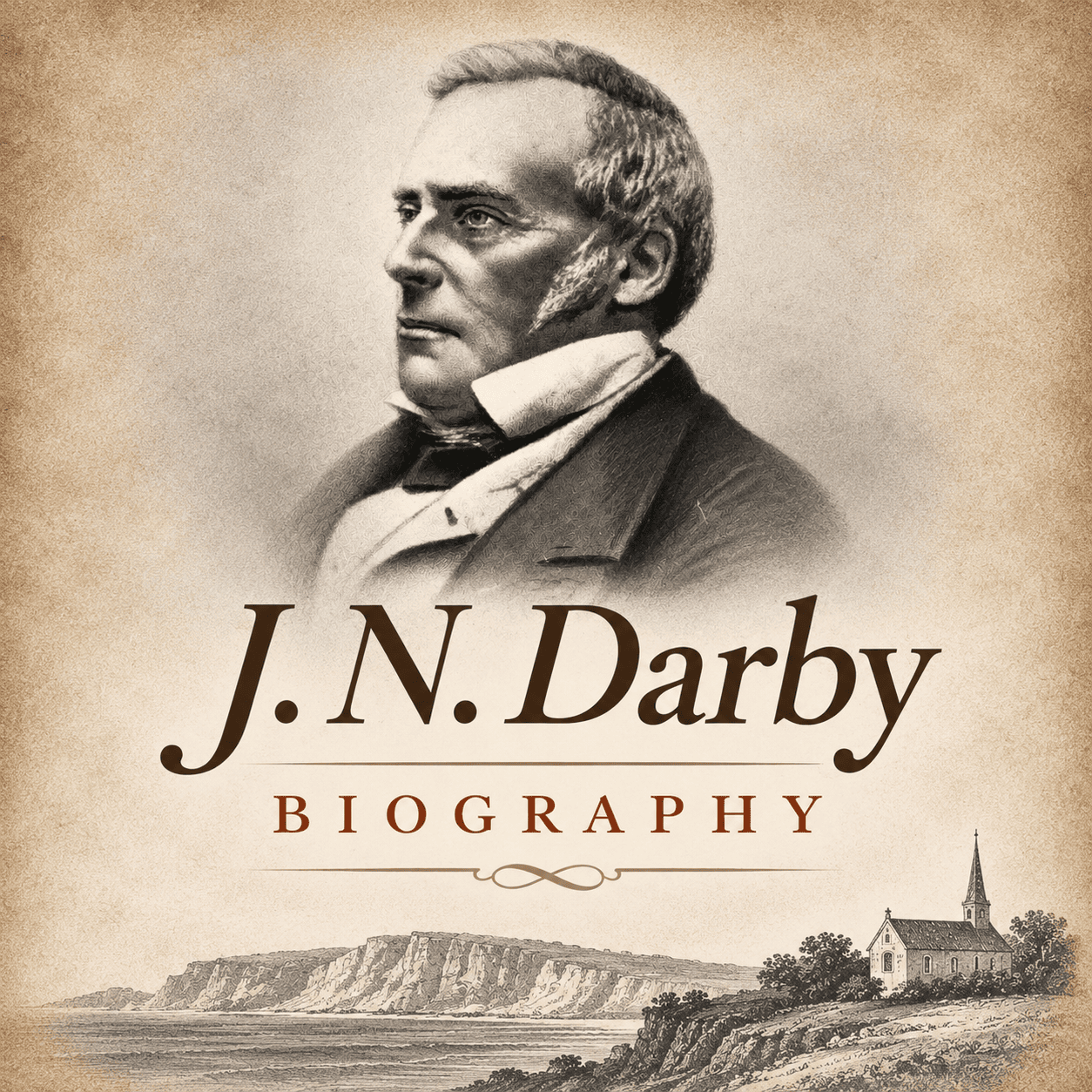
JOHN NELSON DARBY
(18 NOV 1800 – 29 APRIL 1882)
Chapter 1
Mainly Introductory
There are comparatively few among the millions directly or indirectly influenced spiritually by the life and labours of John Nelson Darby who have any clear perception of this man whom Professor Francis Newman described in Phases of Faith as “a most remarkable man, who rapidly gained an immense sway over me.”
One Oxford man indeed styled him “the Tertullian of these last days” from the many controversies in which he was engaged during his long lifetime.
Since it is only a truism that every movement in the history of mankind has had a personal leader, and that when the hour strikes the man appears, so it was when what an American writer called A Divine Movement began in the first quarter of the 19th century. This movement commonly designated “Brethren,” frequently miscalled “Plymouth Brethren,” found a living, forceful, personal leader to voice, lead and extend it as far as a man could, in the subject of this volume. For over half a century of active unwearied service he diligently taught and practised the truth that, whatever the prevailing ecclesiastical disorders, there still remains the duty and privilege for every member of CHRIST’s body strenuously to maintain the unity of the SPIRIT in the bond of peace (Eph. 4:3).
His conception of this “body,” the Church, noble and sublime, differs widely from that advocated by many in high ecclesiastical positions, yet cannot fail to appeal to the spiritual mind. He says, “The Church … a lowly, heavenly body … has no position on earth at all, as it was in the beginning — suffering as its Head did, unknown and well known — an unearthly witness of heavenly things on earth.”
Chapter 2
Ancestry, School, University
JOHN NELSON DARBY was born at Westminster, in his father’s London house, on November 18th, 1800. He was the youngest son of John Darby, of Markley, Sussex, and of Leap Castle, King’s County, Ireland. His mother was of the Vaughan family, well known in Wales, whilst on his father’s side he was of Norman extraction, the family records going back before the Reformation. His uncle, Admiral Sir Henry Darby who commanded the Bellerophon in the Battle of the Nile, was a friend of Lord Nelson, and he, to the great delight of the parents, consented to be one of the sponsors at the christening of his friend’s little nephew.
Hence the second Christian name given in compliment to England’s naval hero. His mother’s death when he was only five years old, made a deep and lasting impression upon young Darby. And the tender memory which he cherished in his heart of her would sometimes find expression on unexpected occasions. When he was fifty years of age we find him writing of her thus: “I have long, I suppose, looked at the portrait of my mother, who watched over my tender years with that care which only a mother knows how to bestow.
I can just form some imperfect thought of her looks, for I was early bereft of her; but her eye fixed upon me that tender love which had me for its heart’s object — which could win when I could know little else — which had my confidence before I knew what confidence was — by which I learnt to love, because I felt I was loved, was the object of that love which had its joy in serving me — which I took for granted must be; for I had never known aught else. All that which I had learnt, but which was treasured in my heart and formed part of my nature, was linked with the features which hung before my gaze. That was my mother’s picture. It recalled her, no longer sensibly present, to my heart.”
He received his early education at Westminster School, In 1815 the family went to reside in the ancestral castle in Ireland, and to young Darby it was his first visit to that country. He then at the age of fifteen matriculated at Trinity College, Dublin, and in this entirely congenial atmosphere his whole nature seemed at once to expand. He made rapid strides, becoming Classical Gold Medallist on the shorter time of a Fellow-Commoner for his degree in his nineteenth year. These four happy years were followed by three during which he studied for the Bar, and in 1822 he was called to the Irish Chancery Bar, but did not practise; and it is here the secret of his after career begins to reveal itself.
Ever since his eighteenth year he had been greatly exercised about spiritual matters, and being now converted to GOD, conscientious objections arose in his mind as to following a legal profession, however fair the prospects it offered.
After a year, he, to his father’s great annoyance, altogether abandoned the idea of practising as a barrister, and this decision came as a very great disappointment to many who had watched with interest the opening of a very promising career. None perhaps was more disappointed than his brother-in-law, the Lord Chief Justice of Ireland (then Sergeant Pennefather), who hoped not only for his rise to the highest honours in the profession, but that his penetrating and generalising genius would have done much to reduce the legal chaos to order.
To understand this renunciation of an assured position by a young man, brilliant, gifted, talented, well connected, in a circle possessing great influence in the profession which he had entered and already made his mark, by being “called” when only a youth, it will be necessary to revert to a period of seven years in his life which he rarely mentioned. On one occasion, however, in conversation upon deep spiritual experiences with his friend, Mr. William Kelly, he remarked that for seven years he had once practically lived in the 88th Psalm, his only ray of light being in the opening words, “O LORD GOD of my salvation.” To only a select few of GOD’S servants is it given to pass through severe exercise of this character. But the depth and reality of this initial experience undoubtedly gave tone and stability to his life-long witness. Moses at the back of the desert for forty years; Paul in Arabia for three years; all witness to the fact that He Who chooses and calls for special service, trains His servants specially for their life-work.
In the case of Darby the ray of light that had been, as he said, his only glimmer of spiritual hope during the “dark night” of the seven years, ushered him at last into the full blaze of day as he was brought into the knowledge of peace with GOD, and so became filled with the joy of GOD’s salvation. He heard the call, he saw the Hand that beckoned, and unlike the rich, well-placed young man in the Gospel story who made “the great refusal” and went away very sorrowful, John Nelson Darby, also a rich, well-placed young man, made the great renunciation as with a light heart he now set off “to follow on to know the LORD,” and to follow Him at any cost.
Cheerfully abandoning the legal profession as we have already mentioned, and now desiring to find a sphere of lifework wherein to serve GOD, he applied for, and was admitted to Deacon’s Orders in the Irish Church in 1825 by Archbishop Magee
Chapter 3
In Labours Abundant
Darby was given a title for Orders from the large, straggling parish of Celery in the mountains of County Wicklow of which he became curate. Here he found just that congenial sphere of labour and scope for his energies which he desired. Living contentedly in a peasant’s cottage on the bog, he threw himself heartily into all the varied duties of his office. Earnest and diligent in his ministrations, strict in churchmanship and conduct, he speedily won a place in the hearts of the poor by his sympathy and considerateness.
In the enjoyment of his work he spent his patrimony in schools and charity, and during the year of his diaconate he exercised a generally beneficial influence over the whole locality. He was no mere hireling or official, but an indefatigable labourer in the service of GOD. Every evening almost he was to be found teaching the peasantry in the cabins scattered amid the bogs in the remote outskirts of the wild country parish he served, seldom returning to his own humble lodging before midnight.
He would no doubt have settled here quite contentedly amongst the wild Wicklow mountain peasantry but for “the Divinity which shapes our ends, rough hew them as we may.” GOD was fashioning a vessel for a wider, almost world-wide, sphere of usefulness. This, however, would only be clearly seen in His own good time and way, and another fifteen months were to elapse before that way was opened.
Meanwhile the year of his diaconate swiftly passed, filled with busy service; then Darby went up to the city to receive the priest’s orders at the hands of the Archbishop which should qualify him for the performance of all the duties of the clerical office.
His restless enquiring mind had, however, from the day of his ordination been disturbed as to the position of an Established Church, but in the enthusiastic discharge of his duties, and the special activities in connection with the Home Mission of that day, these disturbing thoughts had been partially stifled.
Like John Wesley, much of John Darby’s travelling in the wild remote outlying parts of his extensive parish was done on horseback, and this played a great part in what diverted the whole course of his after life. It was an accident happening to him on one of these journeys which precipitated the crisis. His horse shied violently, and in swerving aside flung its rider with great violence against a door-post causing severe bodily injuries.
These necessitated his going away to Dublin for surgical treatment. Here he was detained for some time, and now, during the long period of convalescence, the disturbing thoughts as to the Established Church and his own clerical position returned with unabated force and urgency. The period of enforced leisure while unable to leave the house, afforded an opportunity to examine them more thoroughly.
This is what he says about it: “During my solitude, conflicting thoughts increased; but much exercise of soul had the effect of causing the scriptures to gain complete ascendancy over me. I had always owned them to be the Word of GOD … the careful reading of the Acts afforded me a practical picture of the early church; which made me feel deeply the contrast with its actual present state; though still, as ever beloved by GOD.”
Darby spent the remaining months of convalescence at the house of his brother-in-law where his sister nursed him back to health. By this time he had inwardly broken with the Established Church but had joined no other. The Bishop of Cashel good-humouredly rallied him on leaving the Irish Church by enquiring, “Well, John, you have left us; what church have you joined?”
“None whatever,” replied Darby; “I have nothing to do with the Dissenters, and am as yet my own church.”
His friend, the Rev. James Kelly of Stillogan, sent to enquire, “Why did you leave the Church of England?”
To him Mr. Darby sent a friendly but firm reply. This is what he said: “I find no such thing as a National Church in Scripture. Is the Church of England — was it ever — GOD’s assembly in England? I say then that her constitution is worldly, because she contemplates by her constitution — it is her boast — the population, not the saints. The man who would say that the Church of England is a gathering of saints must be a very odd man, or a very bold one. All the parishioners are bound to attend, by her principles. It was not the details of the sacramental and priestly system which drove me from the Establishment, deadly as they are in their nature.
It was that I was looking for the body of CHRIST (which was not there, but perhaps in all the parish not one converted person); and collaterally, because I believed in a divinely-appointed ministry. If Paul had come, he could not have preached (he had never been ordained); if a wicked ordained man, he had his title and must be recognised as a minister; the truest minister of Christ unordained could not. It was a system contrary to what I found in Scripture.”
As he grew older his zeal in CHRIST’s service did not abate. In early mid life the Continent seems to have possessed a real fascination for Darby in Christian service, and Switzerland looms very largely in that period, visits being repeatedly made to Zurich, Geneva, Vevey, Canton de Vaud, Neuchatel and French Swiss villages. Germany also, where his elder brother laboured for some years in the ministry of the word, is well represented by Elberfeld, Frankfurt and other towns. Indeed, here a marvellous work resulted from his labours. France, where as an octogenarian he still visited, and where his last Continental journey was made in 1880, is represented in the list by Paris, towns and villages on the Pyrenees, Nismes, St. Hippolyte du Fort, etc.; Holland, by Rotterdam,
Plymouth, of course, had many visits from J. N. Darby during the first dozen years of Providence Chapel there; Guernsey too, where his lifelong henchman W. Kelly afterwards resided, and Hull, Hereford, Liverpool, Glasgow and Keswick afford the barest sketch of towns visited by this indefatigable labourer “in word and doctrine”; while his own native Isle was practically covered in his zeal for CHRIST and love of the Irish people. Dublin, Limerick, Mayo, Clare, Kilkenny, Athlone, Clonmel are but names selected at random.
These abundant labours occupied fifty years of strenuous days and months. He enjoyed his work, and the enjoyment increased as strength began to fail, his last happy visit to the Continent, as we have remarked, being when over 80 years of age. He also visited Spain once or twice, but here his unfamiliarity with the language, which he himself confesses in one of his letters, somewhat handicapped him.
It is interesting, too, to know that while in Chicago on one occasion Mr. Darby was invited by D. L. Moody to give a series of Bible readings in Farwell Hall. These were attended by many lovers of the Word of GOD, but unfortunately suddenly came to an abrupt end as the two clashed over the question of the freedom of the will. Mr. Darby held to what Mr. Moody considered extreme Calvinism on this point, affirming that so perverted was man’s will he could not “will” even to be saved, and he based his contention largely on the texts “Which were born not … of the will of the flesh … but of GOD”; and “It is not of him that wills … but of GOD that shows mercy.” Mr. Moody insisted that man as a responsible person was appealed to by GOD to turn to Him and would be condemned if he did not. “Ye will not come to me that ye might have life,” said JESUS to those who refused His message. “Whosoever will” is the great gospel invitation.
The controversy became so heated one day that Mr. Darby suddenly closed his Bible and refused to go on, thus losing one of the great opportunities of his life, as it will seem to many.
Separating from Mr. Moody, Darby did not hesitate to condemn Mr. Moody’s work in his characteristic way. In his letters he warned his followers against it as likely to bring a great increase of worldliness into the Church. It is a striking instance of how prejudice can blind and mislead an otherwise great man. Were he alive to-day how surprised he would be to see the work begun by the great warmhearted evangelist a veritable bulwark against both worldliness and apostasy. Mr. Moody ever confessed his indebtedness to the writings of the Brethren for much help in the understanding of the Word, but it was C. H. Mackintosh and Charles Stanley who had the greatest influence.
Mr. Darby, however, had the greatest patience with the poor, unlettered, simple believers, and at Bible Readings was frequently known to help an uneducated brother out with his questions, and to go patiently over the same ground again and again until the difficulty was cleared up.
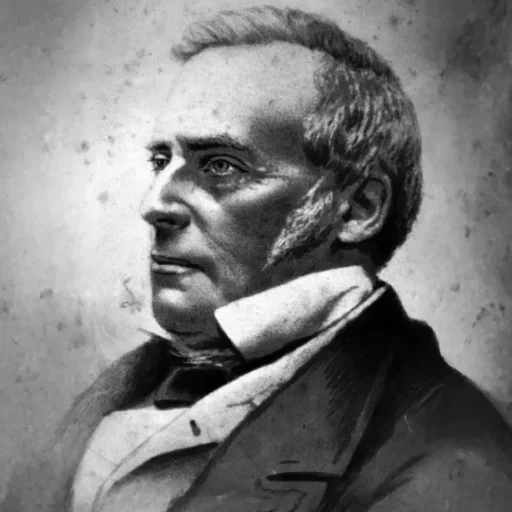
The life of every thinker and teacher in whose nature any marked strain of mysticism appears refuses to be exhaustively treated under the forms of strict chronology. This is specially applicable in the case of Darby, who was so intent on the actual business of living that what has been preserved of his long and varied career is entirely due to the care of others. He objected to being photographed and apparently had no time nor inclination to keep a diary. Words uttered on his deathbed to a physician, “CHRIST is my object in life,” describe his whole course. Like the Apostle of the Gentiles, Darby could say, with half a century of public life to confirm it, “To me to live is CHRIST,” and so to the end, but this did not save him from troubles. He and his work were consistently misunderstood as was to be expected in a Christendom which prizes all those worldly honours that he counted as being valueless. Yet his unrivalled gifts of exposition could not be denied, and of these he was not unconscious.
Chapter 4
A Curate and Two Archbishops
The Oxford man who dubbed Darby the Tertullian of the nineteenth century may possibly have had in mind his trenchant criticisms of two Archbishops, Magee and Whately, the one on Erastianism, and the other on Sabellianism. The former was in connection with a Pastoral Letter which Darby considered as an order to virtually turn the clergy into a religious police in Ireland, purely to curry favour with the English Government of the day. The latter was a few years later in connection with the Irish Education measures of 1832 upon which Darby felt very deeply and expressed himself very strongly, likening it to “the unholy marriage between Infidelity and Popery, whose banns have been first published in this unhappy country” apparently by Dr. Whately himself.
In these controversies Darby’s legal training and theological acumen came into play as the careful reader will duly note. Archbishop Magee had issued a Pastoral Letter which brought to a standstill the Home Mission work into which Darby, then the Curate of Calary, had thrown himself heartily and with great success.
This Pastoral Letter now required all converts from Roman Catholicism to take an oath of allegiance to King George. These converts were just the persons who least needed a guarantee of their loyalty, and on enquiring Romanists it had the most repellent effect, for it seemed to them a question between the Pope and the King, and not of CHRIST at all. Mr. Darby could not stand this, and vigorously protested against it. But Erastianism prevailed, and the qualms and increasingly serious doubts which had perturbed him before, now clamoured for a decision. He would not disobey his diocesan, but he believed it a dishonour to CHRIST’s ministry and Church to create a religious police for currying favour with the Government.
Darby, who had already, as we have noticed, for conscience sake relinquished one lucrative profession, felt he must now abandon another of influence and dignity, as being, to him at least, untenable because unscriptural, and derogatory to the glory of CHRIST. His famous pamphlet on The Nature and Unity of the Church of Christ, afterwards issued later in the first volume of the Christian Witness dates from this time. The one-time curate of Plymstock in Devon was the first Editor of the Christian Witness, and so heartily was he in agreement with Darby that no less than fourteen lengthy articles from the latter’s pen appear in the first number, including the one on The Nature and Unity of the Church of Christ. It is interesting to note that before Darby published this pamphlet he had copies of it printed, and sent privately to the Archbishop himself, and to all the clergy of the diocese.
His churchmanship had received a severe shock, but for a time he continued in his mountain curacy, also occasionally visiting other parts of the country to preach, or speak at meetings of the various religious Societies.
Some twenty-five years later, a heterodox teacher with whom Darby also dealt very faithfully, remarked, “J.N.D. writes with a pen in one hand and a thunderbolt in the other.” But it was only fundamental error which roused his deepest grief and indignation, his patience with honest blunderers being proverbial.
Chapter 5
Character and Principles
(“This is true greatness, to serve unnoticed and work unseen.” — J.N.D.)
Among the friends mentioned in a previous chapter whom he had made in Dublin on the occasion of his earlier visit there in 1827, were some young men who, like himself, had been seriously exercised about their ecclesiastical associations. Much of their difficulty arose from the very rigid denominationalism which then prevailed among Churchmen and Dissenters. Since those days times have considerably changed in this respect, looser conditions today however are as unscriptural as the old sectarianism of yesterday, and scarcely a change for the better. Laodiceanism largely characterises the present age.
So when the ecclesiastically disillusioned young curate of Calary arrived in Dublin in the winter of 1827-28 he found at least four of these friends prepared to take, what then was, a very bold step indeed. Through a close and prayerful study of the New Testament they found themselves unable to find an expression in any practical form of the church of GOD either in the national Establishment or in any of the Dissenting Societies. These latter could only be entered by pronouncing their peculiar “Shibboleth,” and certainly by their constitution never for a moment contemplated the large yet holy nature of CHRIST’S body on earth.
Their bold step was to meet on the LORD’S day morning to “break bread” as in the early days of Christianity, when “upon the first day of the week the disciples came together to break bread” (Acts 20:7).
Not very startling to-day, perhaps, when the influence of Darby’s teaching has been widely felt in Christendom; but then, it was revolutionary, and something “not done” in orthodox religious circles.
It is not by any means certain that these five brethren — Mr. J. G. Bellett, Dr. Cronin, Mr. Hutchinson, Mr. Brooke and Mr. Darby — who met thus for mutual fellowship in the breaking of bread at Fitzwilliam Square, in Mr. Hutchinson’s house, had already completely severed their connection with the various bodies to which they had belonged, but it is very clear that they were getting free from the grave-clothes of merely human systems of religion, and were well on the high road towards that liberty of worship and service which the SPIRIT of the LORD alone can make effectual in the soul. The consideration of the truth found in Matthew 18:20; Romans 12; Ephesians 4:3-4, appears to have been largely instrumental in influencing their course of conduct at this time.
As any one of these five would afterwards have expressed it, and all substantially did so, they had discovered that intelligently to worship the FATHER in SPIRIT and truth, and direct responsibility to serve the LORD, while awaiting His return, compose the proper sphere of the believer’s aspirations here on earth (John 4:23-24; Col. 3:23-24).
What our LORD said to the believing Jews (John 8:31-32) seems to have had special application in the case of Darby. “If ye continue in My word, then are ye My disciples indeed; and ye shall know the truth, and the truth shall make you free.” He became a disciple indeed, and, to a greater degree than many, rejoiced in the freedom which truth confers.
After resigning his curacy, Mr. Darby made it abundantly evident that he had neither resigned the holy ministry of GOD’S Word nor the practical cure of souls; but like a famous John of the previous century had rather taken the whole world for his parish. In many striking respects his after-career resembles that of John Wesley, although their respective attitudes to the Church of England differed very widely. John Wesley could never conscientiously bring himself to separate from the Establishment; John Darby on the other hand, could not conscientiously bring himself to remain within her pale. In missionary zeal, earnestness, devotedness and thoroughgoing evangelism there was, however, much resemblance between these two giants.
In Mr. Darby’s case there was, along with the most enthusiastic and ardent evangelism, clear definite teaching as to the Church of GOD, the Body of CHRIST, the Coming of the LORD, prophecy, dispensational truth, the Word of GOD, the operations of the SPIRIT, with the calling and privileges of the Church. In the early days of his ministry; at Powerscourt Castle; and subsequently, in various centres of England, great attention and interest was aroused by this teaching. Sixty or seventy of the most devoted clergymen and some Dissenting ministers attended the meetings and enjoyed the truth together at one time, until they became alarmed as to whereunto this would grow. Then the inevitable reaction followed; clericalism was in jeopardy!
Despite immense learning, his humility was very striking; his scholarship was never intruded into his ministry. A quaint old divine once remarked that “CHRIST still hung crucified under Hebrew, Greek and Latin.” This was not so in Mr. Darby’s case however; for few ever heard an allusion to the Hebrew or to the Greek in his addresses. So much so that expectant strangers wondered and said, “What is this the great Mr. Darby?”
A common instance of his greatness of character and humbleness of mind occurred at a reading-meeting, where a brother advanced a peculiar theory professedly based upon a quotation from J.N.D’s writings. After a pause of a moment Mr. Darby, with imperturbable gravity replied, “Then J.N.D’s writings are entirely at fault, for it is obvious that this theory is quite unscriptural, and therefore unsound.” Needless to say the good brother had misread and misquoted; had in fact read his own ideas into the book, which is not difficult.
His patience with honest ignorance, his ready tact, his manliness of character, and hearty sympathy, endeared him to many, especially amongst the poorer classes.
Another trait of Mr. Darby’s character, often completely overlooked and quite unsuspected save by the recipient was his wonderful generosity. Mr. J. C. Philpot, the great strict Baptist leader who knew Darby in early days, and Mr. Kelly, his henchman for nearly half a century, were both astonished by this. It sprang from Darby’s diligence in applying practical scriptures to himself, equally with insisting upon those usually considered more ecclesiastical. He was not a professional philanthropist, but a believer in justification by faith, and justification by the works which follow therefrom. His kindly thoughtfulness for his poorer brethren, both in temporal and spiritual need, was most marked.
He possessed to a wonderful degree the faculty of remembering the names and faces of those who had once come under his notice, frequently surprising people thereby. A poor man, who had been unable to make a livelihood in England but anticipated better things in America, was hindered from emigrating through lack of funds. When Darby heard of it, after making due enquiry, he presented the astonished brother with a cheque for fifteen pounds to pay his expenses. Just then the poor man’s circumstances improved, and he decided to stay in England. On his returning the cheque, Mr. Darby remarked, “So you are not going now; never mind, if you should want it, come to me again.”
Neatby, in his History of the Plymouth Brethren, says, “If he (Darby) was ruthless in his ecclesiastical conflicts, he had at other times a singularly kindly and sympathetic nature. In the act of addressing a meeting he would roll up his greatcoat as a pillow for a sleeping child whose uncomfortable attitude had struck him. I have heard that, on one of his numerous voyages, he might have been seen pacing the deck all night with a restless child in his arms, in order to afford the worn-out mother an opportunity of rest; and I doubt whether many children were more tenderly nursed that night. The incident is the more interesting for the fact that Darby never married. Was it the breaking forth of this tenderness, deep-hidden in his lonely heart, that bound men to him in so pathetic a fidelity of devotion?” No wonder that they loved him.
His tender thoughtfulness and consideration for children was markedly displayed during one of his many visits to the United States. A poor brother whose children kept tame rabbits, was extremely anxious to entertain the great man to dinner. The long-wished-for opportunity arrived. Mr. Darby, with the usual Christian courtesy and tact, declined an influential brother’s invitation to dine, but proceeded to the poorer man’s house.
Chapter 6
Friends and Associates
Of friends, in the usual sense of the term, John Nelson Darby had few. His ardent devotion to our LORD, and firm renunciation of much that most men crave after, very effectively hedged his pathway of service from deflection through lesser loyalties. He was a lonely man in many respects, and at times felt conscious of this though never regretting what led to it. As an old man of seventy-nine he gave expression to this in writing Echo of Songs in the Night:
“O! dwell with me; let no distracting thought
Intrude to hide from me that heavenly light:
Be Thou my strength! Let not what Thou hast brought
Be chased by idle nature’s poor delight.”
And when Darby said: “CHRIST has been the only object of my life. It has been CHRIST to me to live,” his character, conduct and conversation certified it as not a mere platitude but simple truth.
When travelling in Italy on one occasion, being then an old man, he reached a very uncomfortable inn where he was to stay for the night. Weary and worn, he leaned his head on his hands, and was heard to say softly:
“JESUS, I my cross have taken,
All to leave and follow Thee.”
Yet he found friends without seeking them, people who were attracted by his decision of character and indifference to worldly advantages of birth, fortune and position. One of them was the Rev. J. C. Philpot, M.A., an Anglican clergyman, one time Fellow of Worcester College, Oxford, who was himself a remarkable man and one who had a somewhat adventurous ecclesiastical career. He met Darby when the latter was staying at his brother-in-law’s house in Ireland, Philpot being at the time resident tutor there. He was deeply interested in Darby’s spiritual exercise when passing through what mystics term “the dark night” of the soul. This kind of distress Philpot, who had become a Hyper-Calvinist, could appreciate; but quite failed to understand Darby’s subsequent joyous sense of complete deliverance, peace with GOD, and assurance of eternal salvation.
During his visits to Oxford in 1830/1, Mr. Darby made contact with two men who were destined to play an important part in his future career. One of these, a Fellow of Exeter College, was Mr. B. W. Newton, a man already recognised as one of learning, piety and ability. The other was Mr. G. V. Wigram of Queen’s College. The former was to become many years later Darby’s chief opponent ecclesiastically, the latter to become a most intimate friend and collaborator for nearly fifty years.
Mr. Newton is described as a man of grave, sober manners, tall and dignified in bearing, polished and scholarly who unconsciously (at least at first) wielded considerable influence over a certain class, especially over people of leisure.
Till the great rupture took place an American writer says: “He remained at Plymouth with the avowed intention of making that place (Providence Chapel) a centre and model for other assemblies, and by printing press and public meetings he sought to oppose what many believed to be the special work of the HOLY SPIRIT in recovering precious truth long lost through the Church’s declension and partial apostasy.”1
The other man to whom reference has been made at Darby’s visits to Oxford in the early thirties, Mr. G. V. Wigram of Queen’s College, became as we have noticed a life-long friend of his. Though never great as a writer or a speaker, in both of which his friend Darby excelled, Wigram was characterised by a singular spirituality and devotedness of life; by decision where CHRIST was concerned and love for His flock.
These qualities together with his moral power gave him justly a very high place in the esteem of J. N. Darby, and indeed of many others who knew him. His chief published works were The Englishman’s Hebrew and Chaldee Concordance to the Old Testament, and a cognate one to the Greek New Testament. He was a wealthy man, and expended fifty thousand pounds upon the production of these volumes which took ten years to be completed by a band of the ripest scholars in the United Kingdom. Yet so truly humble-minded was he that this great sum of money expended by him was referred to by him as only money passing through his hand, reckoning himself simply GOD’s steward in the matter.
Another rather unusual work of his was The Present Testimony, a learned periodical edited by him, in which critical papers on the Divine Names in the Psalms appeared and their appropriate designations. These Papers and Letters were afterwards published in three volumes. In later life he travelled to the West Indies and New Zealand where his kindly gracious pastoral work was greatly valued. The friendship formed with Darby nearly fifty years earlier was only interrupted when his home call came in 1879.
An even earlier friend of Darby’s was Mr. J. G. Bellett who made the acquaintance of Darby at Trinity College, Dublin. They were both strong classical scholars and both intended to become lawyers and indeed were called to the Bar in Dublin where Bellett practised for a short time. In spiritual things, while Darby as we have seen eventually took Holy Orders, Bellett devoted his leisure to Christian work as a layman.
Their close friendship remained for forty years, and in his last letter Mr. Bellett writes to Darby: “I may never see you again my dearest brother; but I must tell you, as from a dying bed, how deeply from my heart’s soul, I bless the LORD that He ever revealed to me the truth. I came to know you, not as slightly before, but in an apprehension that instinctively bound me to you; and this, now for forty years, has never abated. … I have loved you as I suppose in a certain sense I have loved none other; and now, after so long a time, we are found together in the dear fellowship of the same confession. The LORD be with you, dearest brother, while you assert and adorn the doctrine.”
One who was even earlier than John Nelson Darby in learning Christian liberty, ecclesiastical and ministerial, but only in the germ and much simplicity, was Edward Cronin (afterwards the last Canterbury M.D.). By birth a Roman Catholic, he early came under the rough and ready discipline of his Bishop. It was in Cork that this Roman shepherd finding Cronin reading a Protestant copy of the Scriptures actually knocked him down on the spot, and thus served to open the door for escape. After a long life of devotion and fidelity to the LORD and His people, he passed away in 1882 to be with Him Whom he had devotedly loved and served. His end was more than peace, for constantly upon his lips was the Name of the LORD, and almost his latest utterance was the well-known verse:
“Glory, honour, praise and, power
Be unto the LAMB for ever
JESUS CHRIST is my Redeemer!
Hallelujah! Praise ye the LORD.”
Another with whom John Nelson Darby came for a while into association was Mr. George Muller of Bristol. At one time we find Mr. Muller writing of “two Swiss brethren who have learned the way of truth more perfectly through our brother John Darby”; and during the winter of 1843-44 there occurs in his correspondence the following: “There is one brother among us, who through dear John Darby learned the way of GOD more perfectly in Switzerland”; showing thereby the fellowship in and appreciation of Mr. Darby’s labours felt by Mr. Muller at that period.
Would that it might have so continued. But alas history repeats itself in the ecclesiastical sphere as surely as in the secular; hence, before many months passed we find, if we may be allowed so to say, Paul again withstanding Peter because he was to be blamed. In apostolic times it was pretty evident who was at fault, and if CHRIST Himself and His honour had been equally paramount in His servants’ lives, this sad spectacle would not have been exhibited either at Antioch in the first, or Bristol in the nineteenth century.
Mr. Darby last saw Mr. Muller in July 1849, and they never met again on earth.
It has been well remarked that both were men of GOD in their respective spheres. For to charge Mr. Darby with selfish ambition and the spirit of Diotrephes is as sinful and absurd as to question Mr. Muller’s love for CHRIST and desire to glorify GOD. What in the retrospect clearly stands out is that Darby had CHRIST before him, and Muller, Christians. Also it is well to remember that “the best of men are only men at the best”.
The greatest of Darby’s friends in every way was the late Mr. William Kelly of Blackheath, London. They first made acquaintance in Plymouth in a bookseller’s shop in Whimple Street, and though Kelly was twenty years the junior his reputation as a thoroughgoing Christian brother and writer had already been remarked by Darby. So, as Kelly himself when referring to their meeting says, “very frank and cordial was his (Darby’s) greeting.” They were singularly like-minded, truly taught of GOD in the same school. They had their differences, but not in doctrine, or fundamentals, for everything that was best in John Nelson Darby’s teaching and practice found its ablest exponent and advocate in William Kelly.
Mr. Kelly did not, however, blindly follow his eminent friend, or approve all his ecclesiastical actions, yet some of Darby’s last words on his death bed, taken down by those who did not approve of Kelly’s refusal to acquiesce blindly in an ecclesiastical decision, were: “I should particularly object to any attack being made on William Kelly.” As to Kelly himself, who survived his friend by a quarter of a century, his constant advice to enquiring Christians was, “Read Darby!” so highly did he value his writings. Which of the two was the greater it is not possible to say, for both were spiritual giants, good soldiers of JESUS CHRIST each of whom might have truly said, what neither did say, and yet some even do venture to say:
“My all is on the altar.”
They lived lives of sacrificial service, surrendering all for the sake of Him Whose bondmen they were proud to be. We have already noted the renunciations made by Darby in early days, and may close this chapter by relating how his dearest friend Kelly, having taken highest classical honours at the University, when approached by one with an offer of a post in which he “would make his name in the world,” turned it down with the characteristic enquiry, “which world?”
“O GOD to us may grace be given,
To follow in their train.”
Chapter 7
As Author
John Nelson Darby was a singularly voluminous author, whose works are well worth reading, and yet little likely to be read. He was a man of lofty, lovely character, of simple consistent unostentatious adherence to truth, who cheerfully endured the countless troubles such a man is bound to meet in a world like this. Scandal had no charge to make against him, esteem and love of intimate friends could not say enough in praise of the unworldly devoted life much of which from his twenty-fifth year was lived in quite unsought publicity.
His life covered the momentous period when the foundation of religious life in England seemed shaken by the birth of Tractarianism, the sapping and mining of Higher Criticism, the propagation of Evolutionary theories, and the waves of Revivalism, Irish and American.
Darby was no detached observer of any or all of these movements as will appear in the course of explicating the religious questions and controversies in which he was more immediately involved.
Foremost amongst his works is his Translation of the Holy Scriptures (an entirely free and independent rendering of the whole original text, using all known helps), into German and French, and of the Greek into English. The Revisers used his New Testament, and were astonished at an amount of painstaking research exceeding that of most, if not of all, as two of the best in the company wrote to the late Mr. William Kelly, who had himself revised Darby’s Synopsis of the Bible, and edited his other writings, some thirty to forty volumes in English, French, German, Dutch and Italian.
In the translation of the Scriptures the literary was made to give place to the literal, and hence it is characterised by a certain abruptness of style. This, however, is more than compensated for by the invaluable notes with which it is furnished, and which in the judgment of competent critics betoken true scientific scholarship.
From his twenty-eighth year, till his death at the advanced age of eighty-two, he produced in quick succession works of marked spirituality covering literally the widest field of Scriptural enquiry. He laid bare both Irvingism and Puseyism; the scepticism of Professor Francis Newman and the subtlety of the Cardinal his brother. He exposed Mr. B. W. Newton’s Thoughts on the Apocalypse, as well as his more subtle errors as to CHRIST. He refuted the “perfectionism” of John Wesley, to the delight of the Swiss Free Churchmen, who were, however, not so pleased with his criticism of the spurious Free Churchism and its eldership of Dr. J. H. Merle D’Aubigne. He was as unsparing on Popish error in several works of much research as he was in helping the Free Church of Scotland against the rationalism of the late Mr. W. Robertson Smith.
Then, again, the fearful errors as to sin and its penalty which are abroad, and have been spreading so rapidly — such as annihilationism, non-eternity of punishment, and the various vagaries of eschatological scepticism and infidelity — were fully refuted by Mr. Darby.
His expository works are of the highest value, the Synopsis of the Books of the Bible, in five volumes, being a case in point. This was recommended by Bishop Ellicott to theological students of his diocese. Where is there any single work of any author affording such help to the study of Scripture? Yet several others are comparatively of only inferior worth, Evangelical, Practical, Doctrinal, Ecclesiastical, Prophetic, Miscellaneous, etc.
His Critical Volume is a fund of thought for the student. All are able and scholarly, though some from the nature of the case are profound while others are of quite simple character. They are alike stamped with devotion to CHRIST and faith in GOD’s Word, and surely never was an author more indifferent to literary distinction. He recommended “thinking in Scripture.”
One tiny volume of Spiritual Songs is all that stands to his credit in versification. But the twenty-six matchless pieces, a metrical life of our LORD, a sonnet, some hymns and spiritual songs are a revelation of a devotion, deep, true and tender; the breaking of an alabaster box of choice spiritual perfumes; the outpouring of heartfelt piety in chaste and beautiful expression, which while it enchains the Christian heart constrains it to join its delightsome melody.
While comparisons are proverbially odious, yet the same haunting strains and celestial fragrance which cling around the compositions of some of the mediaevalists: Bernard of Cluny, Bernard of Clairvaux, Abelard, Andrew of Crete (to mention but a selection at random) are here. But here there is no cloying sweetness, no mists of superstition, but a clear spiritual atmosphere where no breath of earth-born clouds intrudes.
This Collection will afford rich enjoyment and blessing to every spiritual mind; but the hymns being the free utterance of what the heart learned with GOD, are without that careful finish that would have been given to mere composition. This, however, increases their reality, and hence their attractiveness, for all who will appreciate their intrinsic excellence.
It is interesting to note that they cover fifty years of a life lived in active service in many lands, by one who was often the unwilling storm-centre of ecclesiastical strife, knowing fully what “scenes of strife and desert life” actually meant; one who voluntarily sacrificed the ordinary comforts of domestic life, and disbursed a fortune in the service of the LORD, all with scant recognition from many who benefited by his self-abnegating piety.
In 1832 he bursts into song with:
“What powerful, mighty Voice, so near
Calls me from earth apart —
Reaches with tones so still, so clear,
From th’ unseen world my heart?
“LORD, let me wait for Thee alone:
My life be only this —
To serve thee here on earth unknown;
Then share Thy heavenly bliss.
“O rest ineffable divine,
The rest of GOD above:
Where Thou for ever shalt be mine
My joy, eternal LOVE!”
Three years later during the intervals of a prolonged and severe attack of gout in the eye, while confined to his bed in a dark room he dictated what is probably his most popular hymn. Its jubilant strain of worship, inspiring and exultant, in no way reveals the distressing malady from which Darby was then suffering, but it clearly indicates the habitude of his spirit. It is entitled “The Endless Song.”
“Hark! Ten thousand voices, crying
‘Lamb of God’ with one accord:
Thousand thousand saints replying —
Wake, at once, the echoing chord!
* * *
“Grateful incense this ascending,
Ever to the FATHER’s throne;
Every knee to JESUS bending,
All the mind in heaven is one.”
Two years later, when a large number of Christians left the Swiss Free Church, after a course of lectures given by Mr. Darby on the Book of Exodus, he wrote the well-known hymn:
“Rise my soul! Thy GOD directs thee;
Stranger hands no more impede:
Pass thou on; His hand protects thee
Strength that has the captive freed.
* * *
“In the desert, GOD will teach thee
What the GOD that thou hast found;
Patient, gracious, powerful, holy —
All His grace shall there abound!
* * *
“Though thy way be long and dreary,
Eagle strength He’ll still renew:
Garments fresh and foot unweary
Tell how GOD hath brought thee through!”
One curious fact in connection with Mr. Darby’s hymn-writing is that many of the finest and most deeply spiritual of them were produced during seasons of very great strain and stress. As we have already noticed, The Saints’ Rest was published during a period of tremendous ecclesiastical unrest and discord, and strangely enough his most exquisite lyrical composition, “We praise Thee glorious Lord!” was written when, as an old weary veteran in 1881, he had again become the unwilling storm-centre of ecclesiastical partisanship, and was written as a cheer for a sick friend; its last stanza expresses what then more than ever was the attitude of J. N. Darby’s heart: —
“JESUS, we wait for Thee!
With Thee to have our part:
What can full joy and blessing be,
But being where Thou art!”
Not many months later, in the November of the same year, we find him writing to another friend about a new hymn, which accompanied the letter: “I send you a hymn, suggested by one you like: but that brought you down to being ‘often weary.’ This goes up to where there is no weariness.”
“I’m waiting for Thee, LORD;
Thyself then to see, LORD!
I’m waiting for Thee,
At Thy coming again:
With Thee evermore, LORD,
Our hearts will adore, LORD:
Our sorrow’ll be o’er,
At Thy coming again.”
To many who view John Nelson Darby as a teacher who has raised up a school of his own, committed to a view of the Church’s calling and character which, whether considered a restoration or an innovation, is certainly revolutionary in its character and results, the foregoing extracts, breathing as they do the simple ardent devotion of his inner life, may appear somewhat strange.
But the career of Mr. Darby is full of strange and strongly marked contrasts. “He always had his surplice in his pocket”; a leader of matchless sagacity, yet with an impetuous impulsiveness that was occasionally a source of embarrassment to other leading brethren, his life resembles a landscape with its towering rocks and solitudes; its verdant meads and meandering streams; its rushing torrents and calm lakes; each of which in turn stand out upon the canvas as the arresting feature of the picture.
As a man, as a Christian, and as a scholar he was and is held in the highest respect by all who knew him, save indeed those who permit themselves to be blinded by prejudice or invincible party feeling. His unchallenged consistency, sincerity and unwearied service to the faith to which his soul was yielded in his early years commands the reverence and admiration of those who recognised in him a spiritual guide.
But there is always need for caution lest this admiration of a Christian leader’s intellect and spiritual qualities should be allowed to pass (unconsciously perhaps at first) into an unwarranted and dangerous deference to his authority, or even into a passive acquiescence in all his teachings, as though it were impossible for such a man to err in any point of faith or practice.
As Writer — Theologian — Poet, Darby, with some forty volumes of prose and one of exquisite verse, left a legacy of sound doctrinal literature, in which the devout scholar and simple believer alike, may find edification, exhortation and encouragement.
His conception of the Church, noble and sublime, differs widely from that advocated by many in high ecclesiastical positions, but cannot fail to appeal to the spiritual mind. He says, “The Church … a lowly heavenly body … has no portion on earth at all, as it was at the beginning — suffering as its Head did, unknown and well known — an unearthly witness of heavenly things on earth.”
Chapter 8
Some Pen Portraits and Appraisals
1830 (1)
Professor F. W. Newman (brother of Cardinal Newman) who had won an unusually high double First Class at Oxford, became resident tutor at Sergeant Pennefather’s, Mr. Darby’s brother-in-law. Here he saw a good deal of Darby who was then staying there invalided. This is what he says of him:
“After taking my degree, I became a Fellow of Balliol College; and next year I accepted an invitation to Ireland, and there became private tutor for fifteen months in the house of one now deceased, whose name I would gladly mention for honour and affection — but I withhold my pen. While he paid me munificently for my services, he behaved towards me as a father, or indeed as an elder brother, and instantly made me feel as a member of his family. His great talents, high professional standing, nobleness of heart and unfeigned piety, would have made him a most valuable counsellor to me; but he was too gentle, too unassuming, too modest; he looked to be taught by his juniors, and sat at the feet of one whom I proceed to describe.
This was a young relative of his, a most remarkable man, who rapidly gained an immense sway over me. I shall henceforth call him ‘The Irish Clergyman.’ His bodily presence was indeed ‘weak.’ A fallen cheek, a bloodshot eye, crippled limbs resting on crutches, a seldom shaved beard, a shabby suit of clothes, and a generally neglected person, drew at first pity, with wonder to see such a figure in a drawing room. It was currently reported that a person in Limerick offered him a halfpenny, mistaking him for a beggar; and if not true, the story was yet well invented.
“Never before had I seen a man so resolved that no word of the New Testament should be a dead letter to him. I once said, ‘But do you really think that no part of the New Testament may have been temporary in its object? For instance, what should we have lost if St. Paul had never written, “The cloke that I left at Troas bring with thee and the books, but especially the parchments?”‘ He answered with the greatest promptitude, ‘I should have lost something; for it was exactly that verse which alone saved me from selling my little library.
No! every word, depend upon it, is from the SPIRIT and is for eternal service!’ In spite of the strong revulsion which I felt against some of the peculiarities of this remarkable man, I for the first time in my life found myself under the dominion of a superior. When I remember how even those bowed down before him who had been in the place of parents — accomplished and experienced minds — I cease to wonder in the retrospect that he riveted me in such a bondage.”
1840 (2)
Professor Herzog of Lausanne, who on Darby’s visit to Switzerland in the spring of 1840 met and heard him; gave his impression of the man and his visit thus:
“He came, preceded by the double reputation of an able pastor and of a teacher profoundly acquainted with the Bible. People spoke in glowing terms of the devotion of a man who, from love to CHRIST and for souls, had renounced almost the whole of his fine fortune; and who displayed in his whole conduct a simplicity and frugality that recalled the primitive times of the Church. It was also said in his favour that, sacrificing the delights of family life, he spent his life in journeying from place to place to gain souls for the kingdom of GOD.
“Notwithstanding that Mr. Darby seeks less to convert souls than to unite under his direction souls already converted, we gladly acknowledge that he deserved to a great extent the compliments that were paid him. There certainly is to be found in him a combination of fine and great qualities. His conversion, we have no reason whatever to doubt, was real and sincere. He is capable of much devotion to the LORD’S cause, and he has given striking proofs of it. He is a man of indefatigable activity, and at the same time of great originality and independence of mind.”
Then somewhat annoyed by the great movements which resulted from Mr. Darby’s visit when a large number of believers left the Swiss Free Church, and were gathered on more simple and Scriptural ground, Professor Herzog qualified the, to him, too adulatory appraisal by caustically adding, “If he had taken a different turn, he might have rendered eminent services to the Church.”
1877 (3)
From the Editor of the Southern Review:
“If he had been an ambitious man, anxious to build up a great and prosperous society, with a view to illustrate his own name, rather than the glory of CHRIST, he might have compromised with Mr. Newton, and thereby saved the society from the schism which followed. But if he had done so, he would have been justly contemptible in the eyes of the true Christian.
If, after withdrawing from other denominations because they were untrue to CHRIST’s Name and Word, he had sanctioned fellowship with him or his allies, in spite of the outrageous dishonour put upon the LORD CHRIST, he would have been among the most inconsistent of men, the most patent of hypocrites. But such was not the character of John N. Darby. On the contrary, finding it impossible to expel Mr. Newton, with his ‘blasphemous heresy,’ from the society at Ebrington Street, Plymouth, he withdrew himself therefrom, and went on with his missionary labours for the blessing and salvation of souls. Dr. Reid complains, ‘Not content with this (his own withdrawal), he called upon Brethren everywhere to withdraw from all fellowship with Mr. Newton.’ He did right.
He was a hero and not a hypocrite; he was a champion of CHRIST, and not a coward. Many of those called ‘Brethren,’ of course, followed the example and call of Mr. Darby; for they were not all apostates. Hence, when the true CHRIST was cast out of the camp at Plymouth, the faithful remnant went forth to seek Him. They refused to worship with the assembly, or to hold communion with the unfaithful brethren, who had set up the false CHRIST of Mr. Newton.
This was the head and front of Mr. Darby’s offending. If his whole life has been of a piece with this (and we have no reason to doubt it has been), then may we safely pronounce him a saint of the highest and purest stamp. He faced heresy in the very society originally formed by himself, even when outwardly most prosperous and flourishing; and, in spite of the obloquy, scorn, and contempt of the brethren once most dear to him, he continued, even as he had begun, to esteem the reproach of CHRIST greater riches than the treasures of Egypt.
The world may pour contempt on such a man; sectarians may dip their pens in wormwood and gall for his destruction; and the eulogists of hypocrites and liars may denounce him as a fiend incarnate; but, in our very heart of hearts, we honour and reverence him as a true soldier of the Cross.”
1900 (4)
From Mr. William Kelly (Editor of The Prospect, The Bible Treasury and of Mr. Darby’s Synopsis and Collected Writings). “I go back to my first intercourse with him in the summer of 1845 at Plymouth. For though I had been for years in communion before this, it had not been my lot to see him for whom above all others I had conceived, because of his love and testimony to CHRIST, profound respect and warm affection. I was then living in the Channel Islands, in one of which I began to break bread with three sisters in CHRIST, before ever looking a ‘brother’ in the face. It was in J. B. Rowe’s shop, Whimple Street, that we met, and very cordial and frank was his greeting. Painful disclosures had already been made of an effort to undermine from within, and to set up, under His Name, Who had taught us liberty of ministry and the unity of the SPIRIT, a state of things contrary to His Word.
“Mr. Darby was then bringing out in numbers the perhaps most valuable critique he ever wrote, in exposure of Mr. B. W. Newton’s Thoughts on the Apocalypse; wherein the main object was to oppose, slyly but with set purpose, every truth which was distinctive of the movement, and all-important in our convictions of GOD’s truth and glory in CHRIST. Nor was the revolutionary effort confined to the retrograde party in Plymouth.
Mr. Chas. Hargrove, an Irish ex-rector; Mr. J. Parnell (was he yet Lord Congleton?), with others, had committed themselves on various grounds to the reaction. Mr. Darby had replied to them all, with an earnest trenchant ability which earned the dislike and resentment of such as love compromise rather than truth. Though grieved to the heart at schism, which must if unjudged lead to what the Apostle calls ‘heresy’ or sect, it was clear to me which cared for CHRIST, and which did not rise above self or their friends.
“To established and non-established, it was just what many leaders of Christendom were desiring; for like the chief priests of old, they doubted whereunto this would grow. As no mean one among them wrote, they began to breathe freely when the Newtonian rent came.
But a little matter of a private kind will interest you and your readers, as it gave me (some twenty years or so his junior) a practical lesson. When dining with Mr. Darby, he by the way said, ‘I should like to tell you how I live. To-day I have more than usual on your account.
But it is my habit to have a small hot joint on Saturday, cold on LORD’s Day, cold on Monday, on Tuesday, on Wednesday, and on Thursday. On Friday I am not sorry to have a bit of chop or steak; then the round begins again.’ I too, like Mr. Darby, had been ascetic as a young Christian, and had been reduced, by general indifference to outward life, so low that the physician prescribed as essential what had been discarded in self-denial.
How uncommon to find a mind endowed with the rarest power of generalisation, able to come down like the Apostle, and impress on a young disciple, eating, drinking, or whatever is done, to do all unto GOD’S glory! At that time Mr. Darby had not a whit of asceticism, but liberty and his heart bent on pleasing the LORD as to necessary food.
To me, however small it might seem to some, it was a hint of daily value, and through me to others; for many a saint, when ‘cleansed from leprosy,’ forgets or neglects, in Levitical phrase, to shave off all his hair, and to wash his clothes, though he may duly bathe. So natural is it, as one of that class said, to retain and give to the LORD his ‘gentlemanship ‘ — a gift abhorrent in His eyes; for it is worldly to the core.
“Mr. Harris, Mr. Newton, Mr. H. Soltau, and many more I of course saw, and found full of kindness, even then when party spirit was doing its deadly work. For in brighter days did not Edward Irving call it a ‘swamp of love,’ when his own mind was carried away by pretensions to miraculous power, and to a ritual beyond the Ritualists?
“But such is the power of spirituality and devotedness, that Mr. Darby was the only one there to whom I felt free to tell confidentially the sad tale of an ex-clergyman’s sin, and to join with me in prayer respecting it. As the evil had come to my knowledge unsought and far away, it devolved on me in faith and love to seek him out, and lay what none, perhaps, suspected upon his soul before GOD. As he had already withdrawn from communion, one could leave all else with Him. No doubt he is long departed, and as no one is alive to guess the one meant, I venture thus to speak.
“It was at a much earlier date (1831, I think) that F. W. Newman invited Mr. Darby to Oxford: a season memorable in a public way for his refutation of Dr. E. Burton’s denial of the doctrines of grace, beyond doubt held by the Reformers, and asserted not only by Bucer, P. Martyr, and Bishop Jewell, but in Articles IX-XVIII of the Church of England. With a smile he said to me, ‘That is the only pamphlet by which I made any money.’
The same visit of his acted more privately (not on Mr. W. E. Gladstone, who saw and heard him then) but on G. V. Wigram, Sir L. C. L. Brenton, B. W. Newton and W. Jarrett, as well as others too halting in faith to make a decided stand and endure the consequences. It was characteristic of those young men that, when once at a conversazione some one remarked, ‘May the LORD give me a living in the beautiful country’ (and he had more than his desire in a Scotch bishopric), Mr. Wigram immediately exclaimed, ‘May He give me to follow and serve Him at all cost!’ He too had his heart’s desire. The Rev. Sir Chas. Brenton hardly quite appreciated J.N.D., if one may judge by his rather severe saying, ‘I never knew a man in whom the two Adams were so strong.’ Sir Charles was rather legal, and suffered from it; so much so that J.N.D. called a few, not long before the former died, for special prayer on his behalf, and not in vain.
“I was unable to attend the conference at Liverpool in the forties, but was present at that which was held in London in 1845. Only on the afternoon of the third day did J.N.D. rise to speak, and this, after a well-known friend had alluded to his silence in singular terms. Mr. D. explained that he had not spoken because so many brothers had a great deal to say.
It was a most impressive discourse; for after many, and not leaders only, had spoken with considerable power and unction, he gave a terse summary, which set their main points in the best position, and then brought in a flood of fresh light from Scripture on the whole theme. During the same Conference a noble personage, who resented D.’s exposure of a foolish and injurious tract by himself, gave way to vehement spleen.
But J.N.D. answered not a word. Another, who was no less unreasonably offended, came into the hall while Mr. R. M. Beverley was telling us what had helped him to what he regarded as the chief truth he had long wanted. The old brother (very deaf) entered, and went as near the speaker as he could, and heard him read a page of his own book, affirming the very doctrine of the SPIRIT’S presence and working, which he himself was abandoning, and for which Mr. Darby had censured him. This incident made no small impression on me of a living God’s ways.
“Mr. Darby was deliberate and prayerful in weighing a scripture; but he wrote rapidly, as thoughts arose in his spirit, and often with scarcely a word changed. He delighted in a concatenated sentence, sometimes with parenthesis within parenthesis, to express the truth fully, and with guards against misconception.
An early riser and indefatigable worker, he yet had not time to express his mind as briefly and clearly as he could wish. ‘You write to be read and understood,’ he once said playfully to me; ‘I only think on paper.’ This made his writings, to the uninitiated, anything but pleasant reading, and to a hasty glance almost unintelligible; so that many, even among highly educated believers, turned away, because of their inability to penetrate sentences so involved.
No one could be more indifferent to literary fame; he judged it beneath CHRIST and therefore the Christian. He was but a miner, as he said; he left it to others to melt the ore, and circulate the coin, which many did in unsuspected quarters, sometimes men who had no good to say of him, if one may not think to conceal the source of what they borrowed. To himself CHRIST was the centre of all, and the continual object before him, even in controversy; nor is anything more striking, even in his hottest polemics, than his assertion of positive truth to edification.
He was never content to expose an adversary, where not only his unfaltering logic, but instant and powerful grasp of the moral side, and above all of the bearing of CHRIST on the question, made him the most redoubtable of doctors.
“It was my privilege, being actively engaged, to hear him very seldom, and this at great meetings in which he ordinarily took a large part; but I remember once hearing him preach (on Romans 5:20-21) to a small company of the very poor; and to a more powerful and earnest discourse I never listened, though in the plainest terms, exactly suited to his audience. The singing was execrable; and he did his best to lead them, for his voice was sweet, and his ear good; but the barbarous noise of the others prevailed, with which he bore in a patience truly edifying, going on with his message quite unmoved.
“A similar case, only more disreputable, of one excommunicated for outrageous profanity, etc., occurred much later. Mr. Darby’s heart somehow was touched, because he came to the meetings, and indeed forced himself to the front, and tried, while unrestored, to appropriate the LORD’S SUPPER. Yet our beloved friend looked leniently on what was very painful to most. He was as far as possible from the ogre which so many fancied, but inflexible against those who assailed CHRIST.
So he himself used to say, ‘I ought never to touch matters of discipline; for I believe the first person, brother or sister, that tells me about things. It is quite out of my line.’ So much was this felt, that I used to pray the LORD that only a true account might first reach his ear.
But every considerate Christian must be aware that the faithful were as slow to spread evil tidings to gain a point, as the light and party-spirited were quick to plead for those they favour, and especially with one so influential as J.N.D. Also, when one of his position and character took up a cause in this one-sided way, as might and did happen, all can conceive how difficult it was for others to convince, or for himself to revise.
Do any blame me for giving these amiable drawbacks? I humbly think that even in a brief sketch it is hardly truthful to omit what has been here touched with a loving hand, and what he himself would have frankly owned. It is not for me to say one word of what is best left in the grave of CHRIST, where my own failures lie buried.
“Thoughtful for others he was indifferent as to comforts for himself, though he did not mind buying costly books, if he believed them of value for his work. Then he was habitually a hard worker, from early morn devoted to his own reading the Word and prayer; but even when most busily engaged, he as a rule reserved the afternoons for visiting the poor and the sick, his evenings for public prayer, fellowship or ministry. Indeed, whole days were frequently devoted to Scripture readings wherever he moved, at home or abroad. But his clothes were plain, and he wore them to shabbiness, though punctiliously clean in his person, which dressy people are not always.
“In middle life he trudged frequently on foot through a large part of France and Switzerland, sometimes refreshing himself on the way with acorns, at other times thankful to have an egg for his dinner, because as he said, no unpleasant visitors could get in there! In his own house or lodging, all was simplicity and self denial; yet if invited to dine or sup, he freely and thankfully partook of what was set before him.
“His largeness of heart, for one of strong convictions and of practical consistency, showed itself in many ways. After he left the Anglican Establishment he preached occasionally at the call of godly clergymen who urged it; but he only appeared for the discourse and was not present at the previous service.
So in France afterwards he preached for pious ministers of the Reformed Church; nor did he refuse the black gown as an academical dress; but when they brought the bands, ‘Oh no,’ said he: ‘I put on no more.’ Again he did not spare, but warmly rebuked the zealots among half-fledged brothers, who were so ignorantly bitter as to apply what the Apostle said of heathen tables to those of the various Denominations.
It was only fundamental error which roused his deepest grief and indignation. This then is my conviction, that a saint more true to CHRIST’S Name and Word I never knew or heard of. He used to say that three classes from their antecedents are apt to make bad brothers: clergymen, lawyers and officers. He himself was a brilliant exception, though a lawyer first and a clergyman afterward.
“A great man naturally, and as diligent a student as if he were not highly original, he was a really good man, which is much better. So for good reason, I believed before I saw him; so taking all in all I found him in peace and in war; and so, in the face of passing circumstances, I am assured he was to the end. Do I go too far if I add, may we be his imitators, even as he also was of CHRIST?”
In a recently issued volume, the following interesting note occurs. One “of the cherished recollections of Dr. Campbell Morgan’s boyhood is his meeting with John Nelson Darby, who had called on a visit to his father. He vividly recalls the almost reverential awe that lay upon him in the presence of that truly great man, and how the awe gave place and the reverence remained, when the visitor spoke kindly to him about his studies.”
Chapter 9
The Last Phase
Incessant travelling with lack of many ordinary comforts at his advanced age, began to tell upon the apparently iron frame of the old warrior. Early in the year 1881 he mentions a bad fall sustained in Dundee on one of his visits to Scotland. This proved to have more serious consequences than he at first imagined, heart and lungs being sensibly weakened thereby. He was well past the eightieth milestone of a life pilgrimage where there had been no loitering nor turning aside for ease. Indeed as his journey progressed the speed seems to have been accelerated since we find him actively engaged in teaching, preaching and visiting assemblies on the Continent in 1880. But the “earthen vessel” was beginning to break, and he writes to a dear friend of that period: “I have not been ill, but knocked up and overworked. … I work morning and afternoon as far as I can, and in the evening let the strain go and indulge in the Word and feed on His love.”
For a time it was impossible for him to rest at night lying down in bed, but sitting up and propped up he could sleep a little. “I was as low as I could well be, and the bad fall I had at Dundee shook me, I do not doubt, more than I thought. My heart and my lungs were a feeble spring to my body, but this like all the rest is in the LORD’s hand. Last night I did not even sit up any part of the night.”
In February 1882, while still very weak from a protracted illness, he wrote to a friend, “I am (through mercy) better: at my age shall never be well, till all sickness is over: but through mercy work half the day.”
In early March he was taken to Sundridge House, Bournemouth, the house of Mr. H. A. Hammond one of his friends. Here for nearly two months he lingered in what Bunyan describes as Beulah Land. It is related that he was very cheerful and rejoiced in the LORD from day to day; that he spoke of and prayed for the Church and for “the unity of the testimony” continually. When his friend Dr. Christopher Wolston asked him whether he had any special thoughts in view of death, he replied,
“There are three things which I have dwelt much upon:
_______
1. GOD is my FATHER, and I am His gift to His Son.
2. CHRIST is my righteousness.
3. CHRIST is my object in life, and my joy for eternity.“
This was on March 9th, soon after his arrival, but on another occasion he remarked:
“I can say, though in great feebleness, I have lived for CHRIST. There is not a cloud between me and the FATHER.”
Sober words uttered at a solemn time by one at last at leisure to review the course. Truly he could echo with deep understanding the swan song of the great Apostle, “I have fought a good fight, I have finished my course, I have kept the faith: henceforth there is laid up for me a crown of righteousness, which the LORD, the righteous judge, shall give me at that day: and not to me only, but unto all them also that love His appearing.”
His last letter to the brethren is typical, and well worth deep consideration; here it is:
“MY BELOVED BRETHREN,
“After years of communion in weakness, I have only bodily strength to write a few lines, more of affection than of ought else. I bear witness to the love, not only in the LORD ever faithful, but in my beloved brethren in all patience towards me and how much more, then, from GOD, unfeignedly do I bear witness to it. Yet I can say, CHRIST has been my only object; thank GOD, my righteousness too.
“I am not aware of anything to recall; little now to add. Hold fast to CHRIST; count on abundant grace in Him to reproduce Him in the power of the FATHER’S love; and be watching and waiting for CHRIST. I have no more to add, but my unfeigned and thankful affection in Him.
“J. N. DARBY.”
Said and taken down later:
“I do add, Let not John’s ministry be forgotten in insisting on Paul’s. One gives the dispensations in which the display is; the other that which is displayed.
“I should particularly object to any attack being made on William Kelly.
At length on April 29th, it was clear to those who watched by him that the end was near, and shortly after, the earthly life of this good soldier of JESUS CHRIST came to its close. He had served the will of GOD in his own generation, and now like a weary traveler fell on sleep, to be with the LORD he had served, and to await with Him and the blessed dead in Paradise that morning without clouds when
“Soul and body re-united,
Thenceforth nothing shall divide,
Wakened up in CHRIST’S own likeness,
Satisfied.”
It was on the 2nd May, a gloriously fine spring day, that all that was mortal of John Nelson Darby was laid to rest in Bournemouth Cemetery. A very large company followed his body to the grave, estimated at a thousand. The effect of their approach to the grave has been described as striking. “Every voice was hushed; and nothing was heard but the tread of many feet, almost as regular as the measured tread at a military funeral.”
The coffin of polished oak, had a brass plate on which was engraved:
John Nelson Darby
Born 18th Nov., 1800
Died in the LORD
29th April, 1882
It was placed on a bier, and by a specially thoughtful arrangement, as the distance to the grave was considerable, as many brethren as possible were enabled to have the privilege of acting as bearers. After a moment or two of complete silence the hymn, “Oh, happy morn,” was sung containing the verse:
“The resurrection-morn will break,
And every sleeping saint awake
Brought forth in light again;
Oh, morn too bright for mortal eyes,
When all the ransomed saints shall rise,
And wing their way to yonder skies,
Called up with CHRIST to reign”
Just as the last note of this hymn died away, a lark rose from the green sward close by, and poured forth its joyous notes. To one, at least, it was in beautiful harmony with the scene. Then with Scripture readings, prayers and hymns the coffin was lowered into its resting place by loving hands of brethren. The service closed with the sung Doxology, so dear to all present,
“Glory, honour, praise and power
Be unto the LAMB for ever!
JESUS CHRIST is our Redeemer:
Hallelujah Praise ye the LORD.”
So “devout men,” “chief men among the brethren” laid his body to rest until the MORNING STAR appears and the shadows flee away. What a moment of rapture that will be, when the glorified MAN of SORROWS shall stand surrounded by the fruit of His soul’s travail, the innumerable company of the redeemed at home in the FATHER’S house with their REDEEMING LORD. Of this John Nelson Darby himself sings in The Hope of Day:
“Yet it must be!
Thy love had not its rest,
Were Thy redeemed not with Thee
Fully blest.”
So great a company were present from London at the burial that a special train had to be put on in the evening to convey them back.
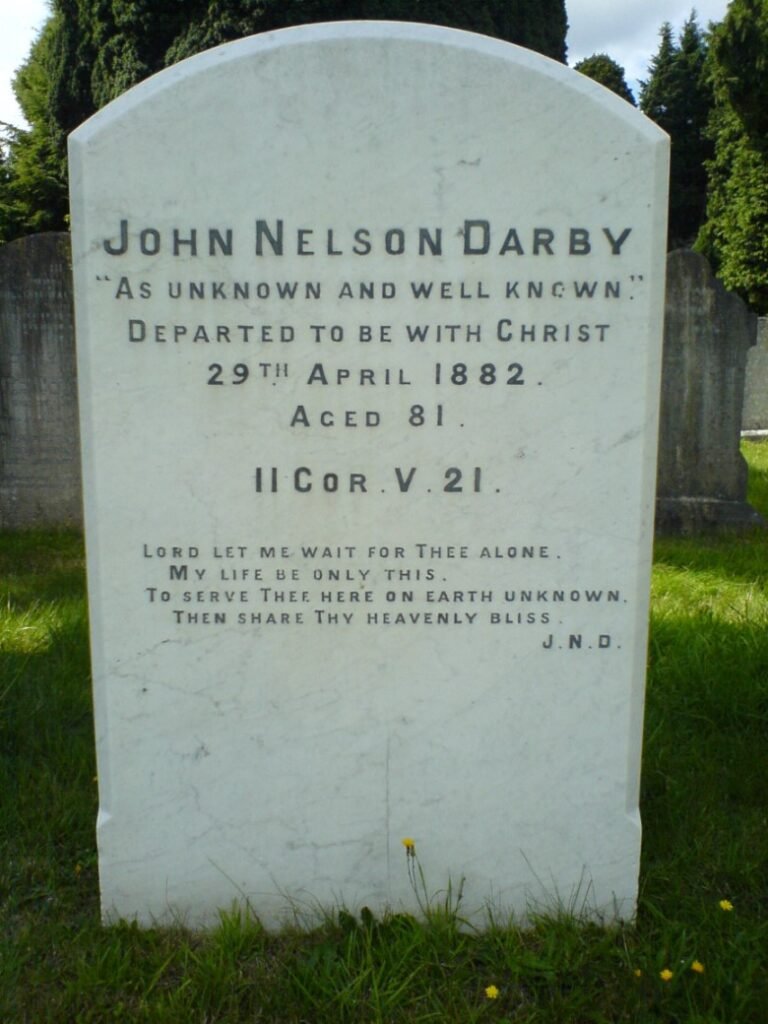
To-day there stands in Bournemouth Cemetery over that grave (around which now so many other graves of brethren who shared like precious faith and hope are clustered) a memorial stone bearing unmistakable testimony to the departed leader and guide, with this inscription:
John Nelson Darby
“As Unknown And Well Known”
Departed to be with Christ
29 April 1882
Aged 81
2 Cor. 5:21.
LORD let me wait for Thee alone,
My life be only this,
To serve Thee here on earth unknown
Then share Thy heavenly bliss.
J.N.D.
Of the subject of the present volume, we can truly affirm that if ever man in this or any other age did with his might what his hands found to do in the service of his MASTER, it was JOHN NELSON DARBY. Now he rests from his labours; but his works still follow him, and “the memory of the just is blessed.
Chapter 10
The Afterglow
That Mr. Darby should have been able to inspire such enthusiasm as he undoubtedly did throughout a long life in men of widely differing temperaments and ranks of Society, and that his influence should still remain a potent factor in the lives of “Brethren” all over the world.
As to the various controversies in which he was engaged, and which ran practically right through his career, it is well to remember the saying of Dr. Ganden: “If either truth or peace must be dispensed with, it is peace and not truth. Better to have truth without public peace, than peace without saving truth.” The temper in which John Nelson Darby engaged in controversy is very instructive; it was alike humble and pious, both very rare qualifications of the controversialist. As he wrote to one on this subject, “If I am useful to any, and the LORD accepts it as service done to Him, I am content.”
Not to secure a triumph in the ecclesiastical arena, but to help the saints and serve the LORD, was J. N. Darby’s ambition when entering the lists with ardour and boldness in defence of the truth.
The lapse of time naturally has, and should have, an influence in softening the asperities of controversy, and particularly in qualifying our estimates of those who have been active in the struggle. It is however possible to allow this tendency to become too strong, and to forget that we are called to the same conflict; that we too must fight the good fight, and keep the faith whole and undefiled, until we finish the course.
This, however, does not warrant the misusing of extracts from his voluminous writings to justify on one hand some rooted prejudice of narrow mindedness, nor, on the other hand, the attempt to bolster up loose preferences as to Christian fellowship or service.
To study Darby will not make the Christian student a Darbyite, nor a so-called Brethren. It will help immensely to make him an instructed disciple, a man of GOD with a mind well furnished in divine truth. He will also discover that “old foes with new faces” in the theological arena have been met and faced by this good soldier of JESUS CHRIST. Indeed the intellectual reader will note that much “modern thought” is really the resuscitation of “ancient errors” long since exploded. This business of dealing in theological and ecclesiastical antiques is strongly supported by the Devil as generation after generation acclaims the old theories as “new light” or “modern thought.”
In his preface to The Synopsis of the Books of the Bible, which the Bishop of Gloucester, Dr. C. J. Ellicott, Editor of his well-known Commentary, recommended to the theological students of his diocese, Darby says: “The reader … is not to expect a commentary, nor, on the other hand, to suppose that he has a book which he can read without referring continually to the word itself in the part treated of.
The object of the book is to help a Christian, desirous of reading the word of GOD with profit, in seizing the scope and connection of that which it contains. Though a commentary may doubtless aid the reader in many passages in which GOD has given to the commentator to understand in the main the intention of the SPIRIT of GOD, or to furnish philological principles and information, which facilitate to another the discovery of that intention; yet if it pretend to give the contents of scripture, or if he who uses it seeks these in its remarks, such commentary can only mislead and impoverish the soul. A commentary, even if always right, can at most give what the commentator has himself learned from the passage. The fullest and wisest must be very far indeed from the living fulness of the divine word. The Synopsis has no pretension of the kind.
Deeply convinced of the divine inspiration of the scriptures, given to us of GOD, and confirmed in this conviction by daily and growing discoveries of their fulness, depth, and perfectness; ever more sensible, through grace, of the admirable perfection of the parts, and the wonderful connection of the whole, the writer only hopes to help the reader in the study of them.
He cannot close this short introduction to the book without expressing the effect which the discovery of the perfectness and divinely ordered connection of the scriptures produces in his mind as respects what is called Rationalism.
Nothing is proved by the system so denominated but the total absence of all divine intelligence, a poverty associated with intellectual pretension, an absence of moral judgment, a pettiness of observation on what is external, with a blindness to divine and infinite fulness in the substance, which would be contemptible through its false pretensions, if it were not a subject of pity, because of those in whom these pretensions are found.
None but GOD can deliver from the pride of human pretension. But the haughtiness which excludes GOD, because it is incompetent to discover Him, and then talks of His work, and meddles with His weapons, according to the measure of its own strength, can prove nothing but its own contemptible folly. Ignorance is generally confident, because it is ignorant; and such is the mind of man in dealing with the things of GOD. The writer must be forgiven for speaking plainly in these days on this point.
The pretensions of infidel reason infect even Christians.
He would add that it has not been his object to unfold the blessed fruits the word produces in the mind and ways of him who receives it, nor the feelings produced in his own mind in reading it, but to help the reader in the discovery of that which has produced them. May the LORD only make the word as divinely precious to him as it has been to the writer; to both ever still more so!”
The influence of Darby’s life and teaching has been discovered in most unexpected quarters. The verger of perhaps the highest Anglican Church in London, where the clergy are sometimes referred to by other clergy as “spikes” because of their extreme Roman and Eastern proclivities, once remarked to the writer, “The Brethren. Ah, yes, my people are Brethren.” An Evangelical clergyman present at an address in a Public Hall given by the writer on “The Bible” shook hands at the close saying, “You are one of the Brethren, I know; many of my friends too belong to them”; though the speaker had given no clue to any denominational affinity in his address.
Some words of Bishop Francis Paget in “Hallowing of Work” may serve to conclude this brief review of the long life of a truly great man. “A man’s gifts may lack opportunity, his efforts may be misunderstood and resisted; but the spiritual power of a consecrated will needs no opportunity, and can enter where the doors are shut … in this strange and tangled business of human life, there is no energy that so steadily does its work as the mysterious, unconscious, silent, unobtrusive, imperturbable influence which comes from a man who has done with all self-seeking.” Such a man was JOHN NELSON DARBY.